
WELCOME TO OUR AUTUMN NEWSLETTER
Matt Cole, Chair, Scottish Fuel Poverty Panel
As I introduce our autumn newsletter, I’m conscious of the difficult winter which lies ahead with energy bills forecast to hit their highest level in three years. The ongoing volatility of global energy markets continues to directly impact households struggling to afford essential heating and power.
The need for long-term, sustainable solutions to fuel poverty has never been greater. The recently published Scottish House Condition Survey local authority breakdown shows again the unenviable record which Scotland’s island communities hold for the worst fuel poverty rates in Scotland and beyond, and we have worked with island stakeholders to understand what could be done to shift entrenched fuel poverty on the islands.
Energy debt now stands at 5.7 billion and we have explored, with others, whether direct reduction of energy bills or cash payments are most effective in supporting households with their energy payments. The picture, of course, is mixed. Scotland is preparing to implement Awaab’s law in October reinforcing the link between warm homes and health, and we have continued to explore the links between fuel poverty and health.
Read on for more about our work and recommendations to Scottish Government on these issues for those living in fuel poverty.
2025-2026 ANNUAL REPORT
The main message of our 2025-26 Annual Report is that Scottish Government needs to give greater strategic prioritisation to fuel poverty policy and programmes than has been the case since the Fuel Poverty (Targets, Definition and Strategy) (Scotland) Act 2019 came into force.
While some progress has been made, Scotland is not yet on track to meet its statutory fuel poverty targets, and faster improvements to home energy efficiency, greater attention to energy affordability and more robust monitoring of outcomes will be essential if fuel poverty targets are to be achieved. These were the messages we set out in our statutory response to the Scottish Government’s first fuel poverty periodic report.
We also deepened our work on fuel poverty in rural, remote and particularly island communities. Fuel poverty in island communities is endemic requiring a bespoke solution to target investment, stronger local delivery capacity and energy market reforms that better reflect island circumstances, matched by funding which recognises the unique challenges faced by island communities.
Another priority was an exploration of the relationship between fuel poverty and health. Research undertaken during the year found significant opportunities to improve health outcomes through warmer homes, better data sharing and closer integration of fuel poverty support within health services.
Alongside these priorities, the Panel continued to influence fuel poverty policy through consultations, advice to ministers and advocacy for a flexible energy discount mechanism. Supported by six panel members and a small secretariat, the Panel remains committed to its vision of a Scotland where everyone can live in a warm, energy-efficient home free from fuel poverty.
INCOME-BASED SUPPORT VERSUS MONEY OFF ENERGY BILLS FOR FUEL POVERTY SUPPORT
In December 2025, the Panel issued a call for evidence to stakeholders to explore the best way to provide fuel poverty support, specifically exploring the advantages and disadvantages of approaches which reduce the money spent on energy versus approaches which increase household income. A range of stakeholders from across the fuel poverty and wider poverty stakeholder landscape provided their insights.
Analysis of the responses demonstrates the complexity that exists in how best to deliver support for fuel poverty (and poverty more generally). Advantages of income-based, or cash-first approaches, include an emphasis on dignity, agency choice and flexibility. Disadvantages are primarily to do with the approach being less effective at reducing fuel poverty as technically defined through the Scottish definition of fuel poverty because additional income is often absorbed by existing debt or urgent costs, without improving energy security or home warmth.
Respondents viewed the advantages of reducing what is spent on energy via money off energy bills as more effectively tackling fuel poverty since funds are guaranteed to be used for energy costs. This approach was, however, seen as limiting flexibility for households to address other urgent needs. There is a risk that payments may be absorbed by existing energy debt rather than addressing current consumption needs. Respondents highlighted that where energy bill support is used to pay off energy debt, rather than support current energy consumption, it undermines the purpose of the policy. It was felt that energy debt should be managed through a separate, dedicated programme.
Most respondents felt that there was a need for a distinct approach to fuel poverty. The reasons given for this primarily related to the existence of fuel poverty’s distinct drivers and the fact that they cannot be addressed through income measures alone. The long and short-term implications of not having adequate funds to pay for energy were emphasised, including the risk of self-rationing, energy debt, and impacts on health and wellbeing.
The Panel has reflected on the fact that fuel poverty support needs to be delivered holistically, recognising that people in persistent fuel poverty are the same people regularly attending health settings and other public services. Investing in preventative, relational support upstream has real potential to reduce that downstream demand, with the potential to provide better value for public money. To deliver this holistic support, the Scottish Government must consider how household
fuel poverty support is delivered but also needs to increase investment in energy efficiency improvements and redesign and increase funding for advice services.
The findings of this analysis strengthen the case for a social tariff. While the Panel recognise the significance of energy debt and its relationship to fuel poverty, it is inappropriate that bill support can be redirected to debt repayment before a vulnerable household sees any benefit from it. A social tariff applied as a unit rate discount avoids this situation, as well as giving individuals more control over energy use. Energy debt should be managed through an appropriate alternative method and level of recovery.
More detailed Panel reflections on these findings are provided in this blog.
FUEL POVERTY IN SCOTLAND’S ISLAND COMMUNITIES
In March 2026, the Panel held a roundtable focused on fuel poverty in Scotland’s islands communities. Ahead of the Roundtable, the Panel held individual bilateral meetings with the three island local authorities (LAs) (Comhairle nan Eilean Siar, Orkney Islands Council, Shetland Islands Council) and the three authorities with islands in their jurisdiction (Argyll and Bute Council, The Highland Council and North Ayrshire Council).
The roundtable explored the nature of and priorities for tackling fuel poverty in island communities with a view to the Panel making recommendations on how the needs of island communities can be represented in the revised Fuel Poverty Strategy.
The images below shows the drivers of fuel poverty in island communities and key mitigations, as identified at the roundtable.
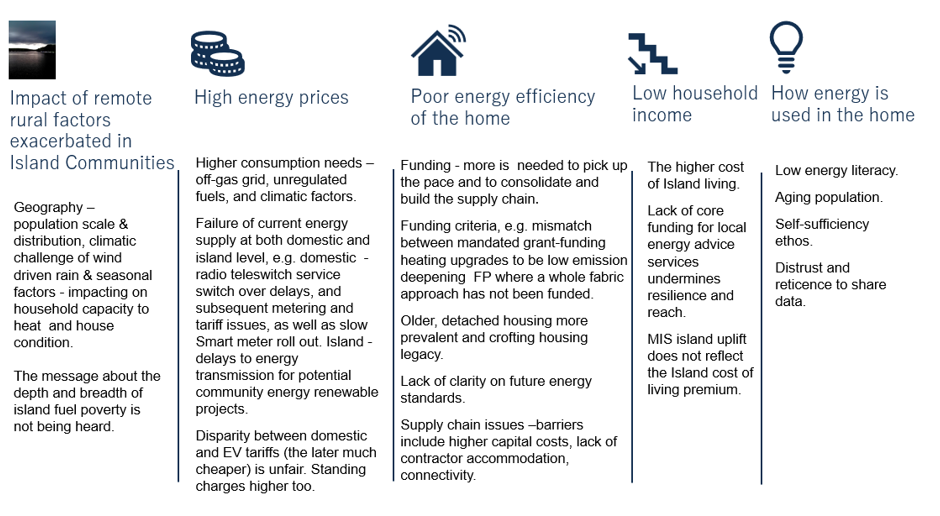
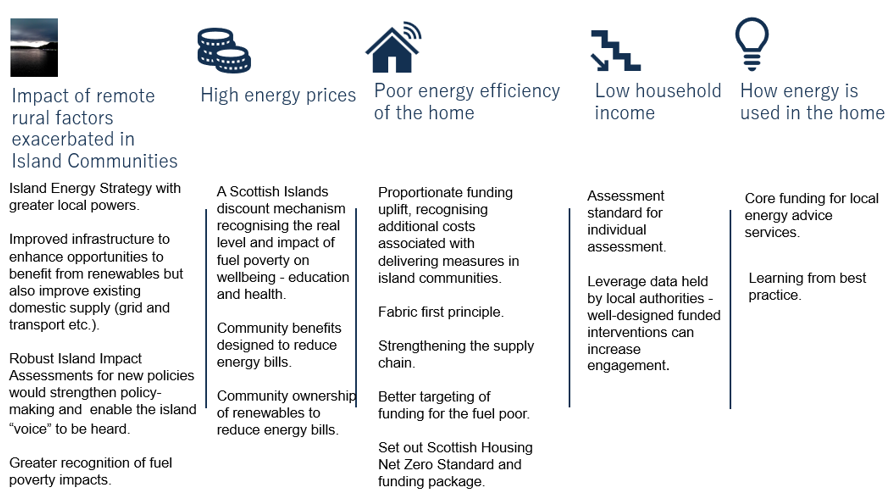
Using the learning from the roundtable and bilateral meetings, the Panel produced five recommendations on mitigating fuel poverty in Scotland’s island communities. These cover:
- Improved energy efficiency and crisis funding to reflect the higher costs of island delivery and the island fuel poverty driver of climatic wind driven rain and seasonal impacts.
- Multi-year and core funding for local advice organisations to improve their resilience, directed through local authorities who understand the support needs of their communities.
- Enhance local authorities’ delivery role through comprehensive resourcing of their local heat and energy efficiency strategy delivery plans.
- Work to ensure that UK energy policy works for Scotland’s island communities, including investigating the pace, location, and connectivity of Smart meters following the switch off of the Radio Teleswitch service to ensure no consumer detriment. And also, advocating for island communities to be prioritised for innovation funding to enable alternative approaches to addressing fuel poverty.
- Work with the UK Government to find new ways for island communities to benefit beyond the current framework to reduce energy costs and fuel poverty. Recognise island energy challenges in policy and through a robust approach to Island Impact Assessments and take the opportunity of the dynamic energy environment to facilitate community wealth creation.
CASE STUDIES OF APPROACHES COMBINING FUEL POVERTY AND PUBLIC HEALTH
In our Spring Newsletter, we updated that the Secretariat hosted a Scottish Graduate School of Social Sciences PhD student for three months. The report our intern, Vanessa Kleinheinz, produced has now been published. To accompany this, the Panel’s Analytical Manager carried out research identifying case studies of approaches which combine fuel poverty and public health.
17 case studies were identified which were grouped into three themes: social prescribing; multi-agency collaboration, and effective use of data. Cross-cutting case study findings indicate that these dual-focused interventions can have positive impacts on wellbeing, comfort, and wider determinants of health, although there is limited robust evidence of long-term clinical health outcomes. Success is strongly associated with cross-sector collaboration, integration within existing healthcare systems, and person-centred, holistic approaches.
However, most initiatives focus on supporting people with existing conditions rather than preventing ill health before it occurs. Furthermore, several challenges remain, including difficulties in identifying and engaging eligible households, securing long-term funding to sustain and expand programmes, and overcoming barriers related to data access, linkage, and governance. Limited evaluation capacity further constrains the ability to demonstrate impact and support the scaling of successful interventions.
In terms of theme specific findings, the following was concluded:
- Social prescribing– evidence of health impact is stronger for larger and better-evaluated social prescribing pilots. In order for the projects to work optimally, data should be used effectively to identify eligible populations and support scaling. There is also a need for effective collaboration between health fuel professionals and those specialising in fuel poverty, and a requirement for sustainable funding.
- Multi-agency collaboration– when establishing projects, it is important to work with existing organisations and community networks in order to increase reach in local communities. These partnership-based approaches often have a positive impact on the wider determinants of health, including stress and isolation. However, consideration needs to be given to capacity and budget constraints of partners, including local authorities, GPs and other health services, and the third sector.
- Effective use of data – the identified case studies show that the use of analytics and dashboards can support more effective population health management and intervention design, as well as improve the identification and targeting of households most likely to benefit from interventions. Furthermore, toolkits and shared methodologies can support replication across regions but consideration needs to be given to what data proxies are appropriate for identifying fuel poverty risk.
The Panel are currently reflecting on these two pieces of research, and intend to build their learning into their wider Fuel Poverty Strategy advice.
2026-2027 WORKPLAN
Looking ahead, this will be a pivotal year for fuel poverty policy in Scotland. With the Scottish Government set to publish a revised Fuel Poverty Strategy in December 2026, a major focus for the Panel will be helping to shape the future direction of fuel poverty policy through our advice to Ministers.
We’ll also be building on our recent work in rural, remote and island communities by publishing our findings and recommendations on the unique challenges facing island households, where fuel poverty remains particularly acute.
At the same time, we’ll be exploring innovative projects and local solutions that are already helping to reduce energy costs, looking at how successful approaches could be expanded across Scotland.
Another important area of work will be the links between fuel poverty and health. We’ll be publishing new research and case studies that highlight the benefits of warmer homes for health and wellbeing, while developing recommendations on how a stronger public health approach can be embedded in fuel poverty policy. We’ll also begin exploring how factors such as age, disability, health, income and housing circumstances can combine to increase the risk of fuel poverty.
Alongside these priorities, we’ll continue to champion a flexible energy discount mechanism, engage with stakeholders across Scotland and the UK, and ensure that lived experience remains woven into our work. By working collaboratively across government, public bodies and the third sector, we’ll continue to foster fuel poverty knowledge and understanding, provide strategic insights and promote practical solutions that reduce energy costs, improve wellbeing and move Scotland closer to ending fuel poverty for good.
If you would like to find out more about any of the stories in this newsletter please contact: enquiries@fuelpovertypanel.scot.